AI Search Results: What the Early Data Tells Us
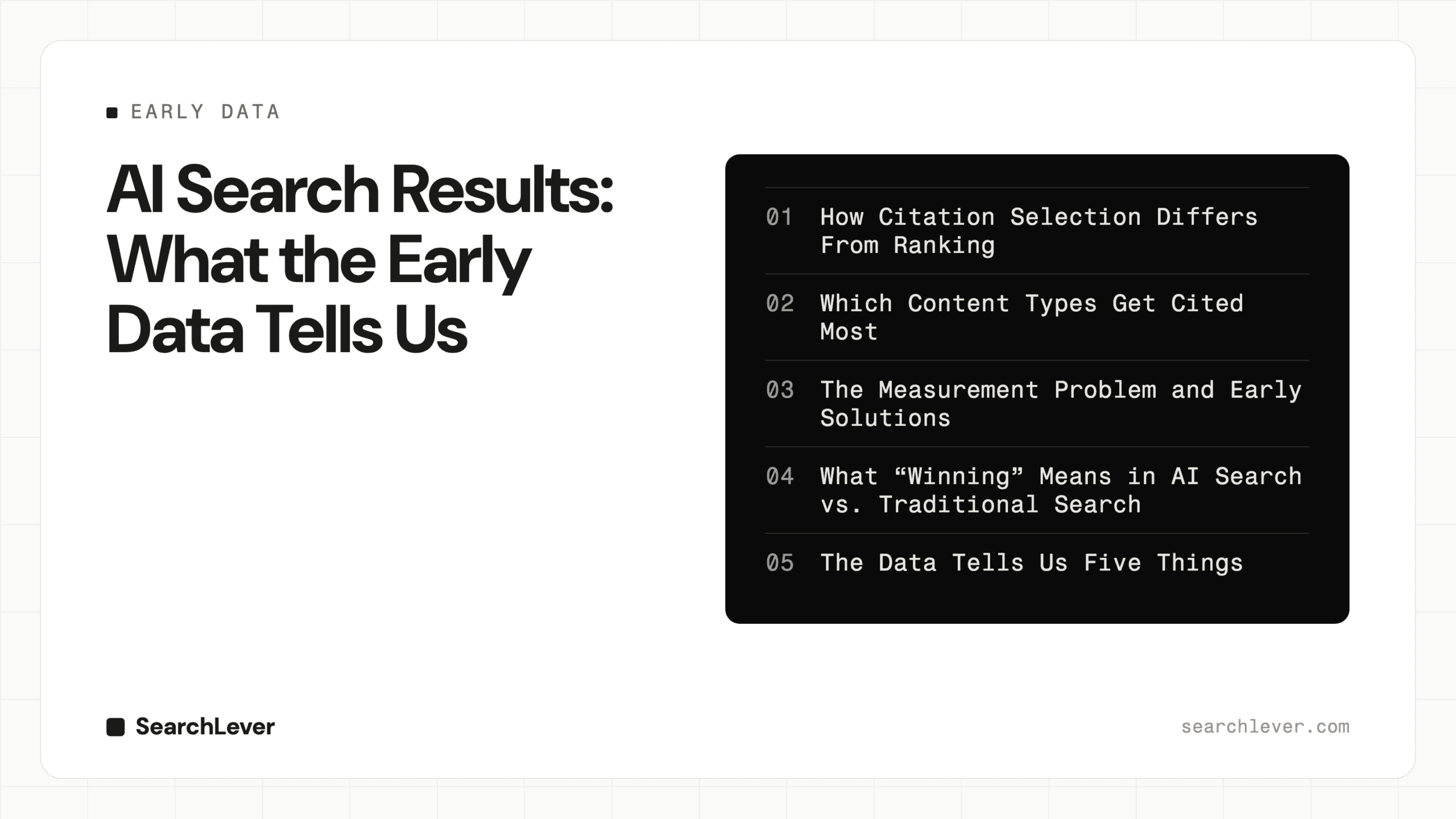
Table of Contents
- What LLM Referral Traffic Looks Like in Analytics
- How Citation Selection Differs From Ranking
- Which Content Types Get Cited Most
- The Measurement Problem and Early Solutions
- What You Can Measure Now
- What Remains Difficult
- What “Winning” Means in AI Search vs. Traditional Search
- The Data Tells Us Five Things
- Where We Stand
- Related Resources
- Frequently Asked Questions
- How do I track LLM referral traffic in Google Analytics?
- What content types get cited most by LLMs?
- Is GEO replacing SEO?
- How much does it cost to build a GEO strategy?
The first real revenue numbers from AI search are starting to surface. One agency published their results last month: $506K in contract value attributed to LLM-driven traffic over four months, with LLM referral traffic growing 7.6x during that period.

Those are not projections. Those are closed deals tied to a specific channel that most SEO teams have not started building for.
We have been tracking AI search as a pipeline source for the past year, pulling data from client engagements, public case studies, and our own testing across ChatGPT, Perplexity, Claude, and Gemini. The data is still early. Sample sizes are small. Attribution methods are immature. But the directional signals are consistent enough to act on, and the teams that are acting early are seeing outsized returns.
Here is what the data actually tells us right now.
What LLM Referral Traffic Looks Like in Analytics
LLM referral traffic shows up differently than traditional organic search. Understanding these patterns is the first step to measuring AI search as a channel.
Referrer strings. Traffic from ChatGPT appears with referrer domains like chat.openai.com or chatgpt.com. Perplexity traffic shows perplexity.ai. Claude traffic from the web interface shows claude.ai. Some LLM traffic arrives with no referrer at all (direct or stripped), particularly from API integrations and mobile apps that do not pass referral headers.
In Google Analytics 4, this traffic typically lands in the “Referral” channel grouping by default, not “Organic Search.” If you have not created a custom channel group for AI search, your LLM traffic is mixed into general referral alongside every other site that links to you. The first step is creating a channel definition that captures known LLM referrer patterns into a dedicated “AI Search” or “LLM Referral” grouping.
Traffic volume patterns. LLM referral traffic is currently a fraction of traditional organic. For most B2B SaaS sites, we see LLM referrals representing 1% to 5% of total organic sessions. That number is growing month over month, but expecting LLM traffic to replace Google traffic in 2026 is premature. The value is not in volume. It is in intent quality.
Session behavior. LLM-referred visitors behave differently than Google-referred visitors. The patterns we observe across client sites:
- Higher engagement rates (time on page, scroll depth). These visitors already have context from the LLM’s synthesized answer. They arrive to verify, go deeper, or take action. They are not scanning search results to find the right page.
- Lower bounce rates. LLM citations are contextually targeted. The model cited your page because it matched the user’s specific query. The relevance bar for a citation is higher than the relevance bar for a search result ranking.
- Higher conversion rates on pipeline actions (demo requests, contact forms, trial signups). Early data from the agency reporting the $506K number showed LLM-referred visitors converting at roughly 2x the rate of traditional organic visitors. Our own client data shows a similar pattern, though the sample sizes are too small to call it statistically definitive.
The dark traffic problem. A meaningful percentage of LLM-influenced traffic is invisible in analytics. When a user reads an LLM response that mentions your brand or product, then opens a new browser tab and types your URL directly, that shows up as “Direct” traffic. When they search your brand name in Google after seeing it in an LLM response, that shows up as “Organic Search” branded traffic. Neither is attributed to the LLM.
This means the 7.6x growth figure from direct LLM referral tracking almost certainly understates the total influence. Brand lift from LLM mentions is real but difficult to isolate with current tooling.
How Citation Selection Differs From Ranking
The mechanics of getting cited by an LLM are fundamentally different from the mechanics of ranking in Google. Understanding this distinction is critical for SEO teams transitioning into GEO.
Google ranks pages. LLMs cite answers. In traditional search, the unit of competition is the page. You optimize a page for a keyword, build authority to it, and compete for position in a ranked list. In AI search, the unit of competition is the answer. The LLM does not care which page you put the answer on. It cares whether your content contains a clear, authoritative, extractable answer to the user’s question.
A page that ranks first on Google for a keyword might never get cited by an LLM if the answer is buried in paragraph seven below a narrative introduction. A page that ranks on page two of Google might get cited consistently if it contains a direct, well-structured answer in its opening paragraph.
Citation is binary, not positional. In Google, the difference between ranking third and ranking eighth is a gradient of declining click-through rate. In LLM responses, you are either cited or you are not. There is no “ranking fifth” in a ChatGPT answer. The model either selects your content as a source or it selects someone else’s. This binary dynamic makes citation optimization higher stakes per query but also more rewarding when you win.
Authority evaluation is different. Google uses PageRank, backlink profiles, and hundreds of ranking signals accumulated over years of algorithmic refinement. LLMs evaluate authority through a combination of training data familiarity (is this domain a known authority in the training corpus?), content quality signals (specificity, depth, recency), and retrieval relevance (how well does this content match the user’s exact query?).
For SEO teams, this means some traditional authority signals transfer to GEO and some do not. Domain reputation transfers. Fresh, specific, well-structured content transfers. But a page with 500 backlinks and thin content will lose to a page with 10 backlinks and a genuinely authoritative answer. The weighting is different.
Original data is disproportionately cited. LLMs have already ingested the most commonly available information on any topic during training. Citing any one source for widely known facts provides no value to the model’s response. The content that earns citations consistently is content that provides something the model cannot source from multiple other pages: proprietary benchmarks, unique research findings, specific case study data, novel frameworks, or practitioner-level detail that demonstrates firsthand experience.
This is perhaps the most significant difference from traditional SEO. In Google, you can rank well by producing comprehensive coverage of existing information. In LLM citation, comprehensive coverage of known information is nearly worthless. Only original contributions get cited.
Which Content Types Get Cited Most
Across our monitoring of LLM responses for B2B SaaS queries, certain content types earn citations at significantly higher rates than others.
Structured Q&A pages. FAQ pages and knowledge base articles with clear question-answer formatting are the most consistently cited content type. The structural clarity makes extraction trivial for the model. When a user asks an LLM a question and a web page contains that exact question with a direct answer, the extraction path is the shortest possible. We wrote a full implementation guide on this in a separate piece because the tactical depth deserves its own treatment.
Data-rich benchmark and research pages. Pages containing original statistics, benchmark data, pricing surveys, or industry research get cited at high rates because the data is unique. An LLM answering “What is the average CAC for B2B SaaS companies?” needs a specific data source. If your page contains that data and a competitor’s does not, you win the citation regardless of your relative domain authority.
Comparison and evaluation content. “X vs. Y” pages, tool comparison matrices, and evaluation frameworks get cited when users ask LLMs to help them choose between options. These pages capture high-intent queries at the decision stage, which is why the conversion rates on LLM-referred traffic from comparison content tend to be the highest.
Definition and concept explanation pages. When an LLM encounters a term it needs to define or explain, it reaches for the most authoritative definition available. Companies that define the terminology in their space get cited every time the model references those concepts. This is a compounding advantage: one well-structured definition page can generate citations across thousands of different LLM conversations.
Content types that underperform for citations:
- Long-form narrative blog posts. The answer is typically buried in the middle of the piece. Models prefer extractable structure over narrative flow.
- Gated content. If the answer is behind a form or registration wall, the model cannot access it and will cite an ungated alternative.
- Listicles without depth. “10 Tips for Better SEO” with one paragraph per tip provides surface-level information the model already has. No citation value.
- Thought leadership without specifics. Opinion pieces that make broad claims without supporting data or concrete examples are rarely cited because they lack the verifiable specificity models prefer.

The Measurement Problem and Early Solutions
The biggest barrier to GEO investment is measurement. Traditional analytics was not built to track “how often was my content cited by an LLM.” The $506K attribution was possible because that team built custom tracking. Most teams have not.
Here is what you can measure today and what remains difficult.
What You Can Measure Now
LLM referral sessions. Set up custom channel groupings in GA4 to capture traffic from known LLM referrer domains. Track sessions, engagement, and conversions from this channel separately. This is the baseline metric.
How to implement: In GA4, go to Admin, then Data display, then Channel groups. Create a new channel group. Add a channel called “AI Search” with the condition: Source matches regex chatgpt|openai|perplexity|claude|anthropic|copilot|gemini|you\.com|phind. Apply this channel group to your standard reports.
Citation presence monitoring. Build a weekly cadence of querying the major LLMs with 20 to 30 questions relevant to your domain. Log which of your pages appear in responses, which competitors appear, and what format the cited content uses. This is manual and time-consuming, but it is the most direct measure of GEO performance.
Some tools are emerging to automate this. DataForSEO offers LLM mention tracking through their AI Optimization module. A few startups are building dedicated citation monitoring platforms. The space is immature, but the tooling is coming.
Content extraction rate analysis. Compare LLM referral traffic across your pages. Pages with structured Q&A content, schema markup, and clear heading hierarchies should receive more LLM referral traffic than unstructured pages covering similar topics. If they do not, your structural optimization needs work.
GSC query evolution. Monitor whether your Google Search Console query profile is shifting toward more conversational, question-format queries over time. This indicates that LLM-influenced search behavior is changing how users interact with traditional search as well. An increase in question-format queries (starting with “how,” “what,” “why,” “can”) suggests your content is being discovered through LLM conversations that then drive Google searches.
What Remains Difficult
Full-funnel attribution. Connecting an LLM citation to a closed deal requires tracking the user from the LLM response through your site to a conversion event to your CRM. The $506K figure came from a team that built this pipeline. Most marketing stacks do not have it wired up. Until your CRM can attribute pipeline to an “AI Search” source, you are measuring traffic and engagement, not revenue.
Brand lift from mentions. When a model mentions your brand in a response but the user does not click through, you get zero analytics data. The brand impression happened. The awareness was created. But you cannot measure it. This is the AI search equivalent of billboard advertising: you know it works in aggregate, but attributing a specific conversion to a specific impression is extremely difficult.
Cross-model performance variance. ChatGPT, Perplexity, Claude, and Gemini all have different retrieval behaviors, citation frequencies, and content preferences. A page that gets cited consistently by Perplexity might rarely appear in ChatGPT responses. Testing across all models is necessary, and there is no unified dashboard for cross-model citation analytics.
Counterfactual analysis. How do you measure what would have happened without GEO investment? You cannot A/B test LLM citations the way you can A/B test a landing page. The best proxy is comparing citation rates and LLM referral traffic between optimized pages and unoptimized pages covering similar topics on the same domain. But the comparison is noisy because models consider dozens of factors simultaneously.
What “Winning” Means in AI Search vs. Traditional Search
Winning in traditional search is well-defined: rank higher than competitors for target keywords. Drive more organic sessions. Convert those sessions into pipeline. The metrics are established, the tools are mature, and the optimization loop is well understood.
Winning in AI search is a different game.
Answer presence over traffic volume. The metric that matters most in GEO is how often your content appears in LLM-generated answers across your target query set. A page that receives 50 organic visitors per month but is cited in 500 LLM responses per month has more brand exposure than a page that receives 5,000 organic visitors but zero LLM citations. The 500 citations put your brand in front of potential buyers at the exact moment they are evaluating solutions.
Category authority over keyword dominance. In traditional SEO, you can win by targeting specific long-tail keywords with focused pages. In GEO, models evaluate whether your domain is authoritative on a topic, then decide whether to cite you for any query within that topic. The investment is in building comprehensive topical coverage, not targeting individual keywords. You do not “rank for a keyword” in AI search. You become a trusted source for a category.
Conversion context advantage. LLM-referred visitors arrive with more context than Google-referred visitors. The model has already synthesized information about their question, provided your content as a credible source, and the user has chosen to click through for more detail. This pre-qualification means the visitor is further along in their decision process. The conversion rate differential (roughly 2x based on early data) reflects this.
Compounding citation authority. Models learn which sources are reliable over time. As retrieval-augmented models refine their source preferences, early citation history creates a compounding advantage. Domains that are cited frequently for a topic build a track record that makes future citation more likely. Late entrants face the same kind of catch-up problem that makes competing in established SEO verticals difficult. The moat is forming now.
The Data Tells Us Five Things
Synthesizing what we know from early AI search data:
1. The channel is real. $506K in contract value and 7.6x traffic growth from a single team is not an anomaly. It is what happens when you build for a channel with low competition and high buyer intent. The buyers asking LLMs about your category are in research or evaluation mode. They convert at higher rates than general organic traffic.
2. Structure beats authority. A well-structured page with clear Q&A formatting and direct answers outperforms a high-authority page with narrative content in LLM citations. This inverts the traditional SEO dynamic where domain authority is the primary differentiator. For GEO, content architecture matters more than backlink profiles.
3. Original data is the only differentiator. Content that restates commonly available information does not get cited. The only content that earns consistent citations is content containing data, frameworks, or practitioner detail that the model cannot find on multiple other pages. This raises the bar for content quality but also creates defensible moats for teams that invest in original research.
4. Measurement is solvable but immature. You can track LLM referral traffic today. You can monitor citation presence manually or with emerging tools. Full-funnel attribution from citation to pipeline requires integration work that most teams have not done. But the data infrastructure challenge is engineering, not conceptual. The teams that wire up attribution now will have a head start when the channel scales.
5. The window is competitive, not permanent. Early data shows outsized returns partly because competition is thin. As more teams build for GEO, citation competition will intensify and returns will normalize. The compounding advantage for early movers is real: citation history, topical authority, and content depth accumulated now will be difficult for late entrants to replicate.
Where We Stand
At SearchLever, we see GEO as a standalone channel. Not an SEO add-on. Not a feature of traditional search optimization. A distinct channel with its own strategy, measurement, and optimization loops.
The content architecture that wins GEO citations (structured Q&A, original data, entity-rich definition pages, comparison content) shares some infrastructure with traditional SEO (same website, same CMS, some content overlap). But the strategic intent is different, the success metrics are different, and the optimization cadence is different.
Our position is that every B2B SaaS company running SEO should be running GEO measurement in parallel starting now. Not because GEO will replace SEO this year. It will not. But because the data you start collecting today informs the strategy you execute over the next 18 months. The teams that wait for “best practices” to solidify before investing will find themselves in the same position as companies that ignored SEO until 2015: competing against entrenched players with years of accumulated authority.
The early data is clear enough. AI search drives pipeline. Structured content earns citations. Original data creates defensible advantages. Measurement is solvable. The direction is set even if the exact trajectory is still unfolding.
The question for SEO teams is not whether to invest in GEO. The data has answered that. The question is whether you will have citation authority in your category when the inflection point hits, or whether you will be starting from zero while competitors collect the citations you should have earned.
Related Resources
For practical implementation of the trends covered in this analysis:
- Your FAQ Page Is Your New Homepage for AI Search is the tactical implementation guide for the FAQ-as-GEO-asset strategy discussed above.
- GEO vs AEO vs SEO: What B2B SaaS Companies Need to Know breaks down the strategic differences between traditional search optimization and generative engine optimization.
- SEO ROI for SaaS: How to Measure and Attribute Pipeline to Organic covers the measurement frameworks you will need to track AI search alongside traditional organic performance.
- SaaS SEO: The Complete Guide to Organic Growth provides the foundational SEO strategy context that GEO builds on top of.
Frequently Asked Questions
How do I track LLM referral traffic in Google Analytics?
LLM referral traffic appears in GA4 under Traffic Acquisition with referral sources like chat.openai.com, perplexity.ai, and claude.ai. Create a custom channel group in GA4 to aggregate all AI assistant referrals into a single “AI Search” channel. The traffic volumes are currently small (typically 1-5% of organic) but growing at 20-30% month over month in B2B categories.
What content types get cited most by LLMs?
Structured FAQ pages, data-rich comparison content, and original research with specific numbers get cited most frequently. Long-form blog posts and narrative thought leadership rank well on Google but are cited less often by LLMs because they lack the extractable, self-contained answer structure that language models prefer.
Is GEO replacing SEO?
No. GEO is a separate channel with different mechanics, content requirements, and measurement frameworks. Traditional SEO still drives the majority of organic traffic. GEO adds a new layer that captures buyers during AI-assisted research. The best B2B SaaS companies are investing in both simultaneously, not replacing one with the other.
How much does it cost to build a GEO strategy?
A dedicated GEO FAQ page can be built in 2-3 days of focused work. Ongoing maintenance requires 2-4 hours per month for question audits and answer updates. Compared to traditional SEO content programs that require weekly blog posts and link building, the effort-to-visibility ratio for GEO content is significantly higher. One well-built FAQ page can outperform 50 blog posts in LLM citation frequency.

GTM & Growth Engineering
13+ years building revenue systems across B2B SaaS, fintech, and global operations. Previously at IBM, WorldRemit, Uber, and Janus Henderson. Clay Product Expert. Builds the GTM infrastructure and software layer that ties organic to pipeline.

SEO & Content Engineering
12+ years in technical SEO, currently SEO Manager EMEA at GoDaddy. Previously led SEO for Hawkers Group, Europe Assistance, Klorane, and Puressentiel. Founded Pixel News. Botify Pro certified. Specializes in site architecture, crawl optimization, and international SEO across 5 languages.