How to Choose a B2B SEO Agency: The Evaluation Framework
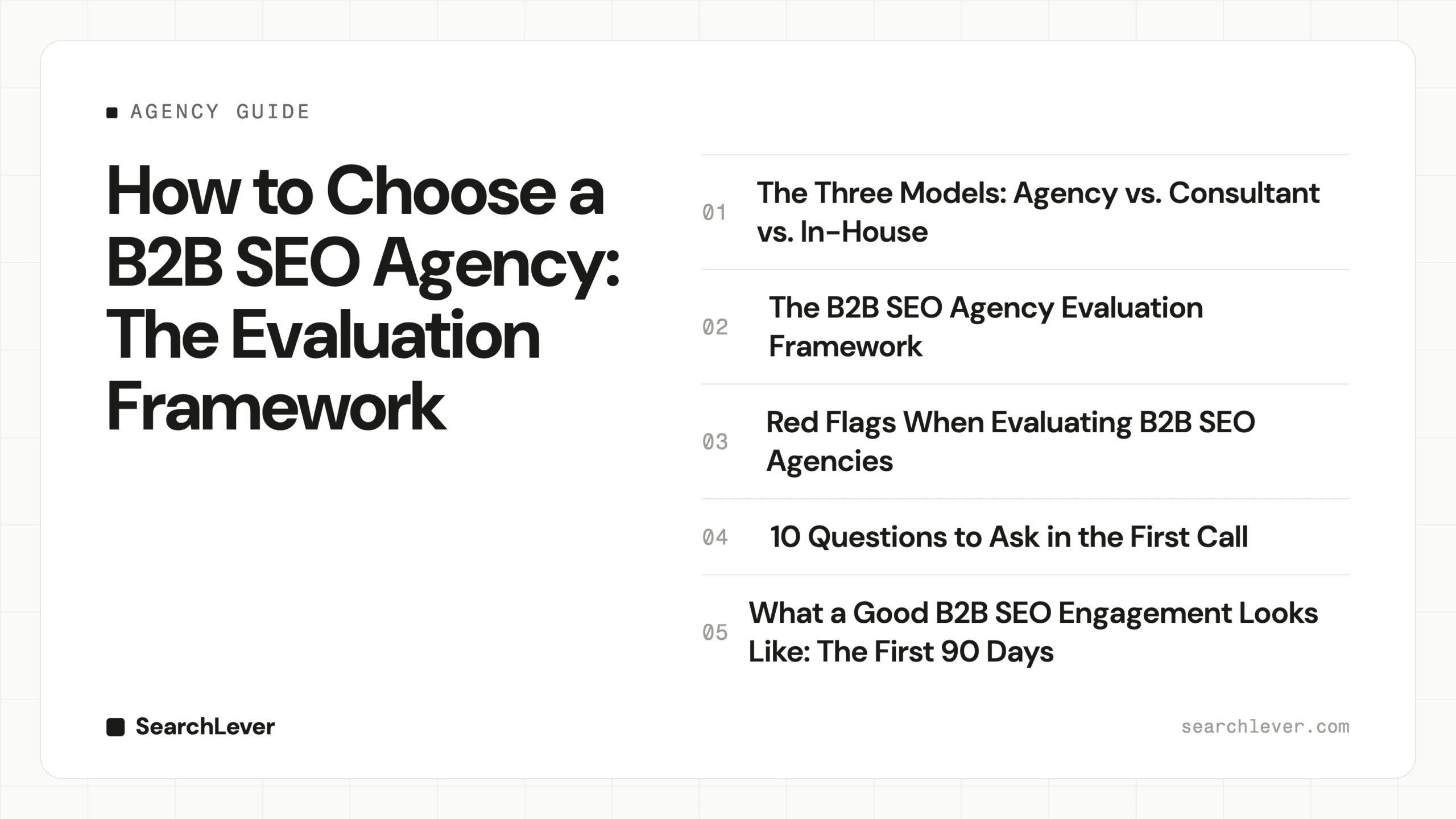
Table of Contents
- Why Getting This Decision Wrong Is So Expensive
- The Three Models: Agency vs. Consultant vs. In-House
- SEO Agency
- SEO Consultant
- In-House SEO Hire
- The B2B SEO Agency Evaluation Framework
- 1. Industry Expertise
- 2. Technical Capability
- 3. Attribution Model
- 4. Team Structure
- 5. Reporting Cadence and Metrics
- 6. Contract Flexibility
- 7. Case Studies and Proof
- Red Flags When Evaluating B2B SEO Agencies
- 10 Questions to Ask in the First Call
- What a Good B2B SEO Engagement Looks Like: The First 90 Days
- Days 1–14: Discovery and Audit
- Days 15–30: Strategy and Roadmap
- Days 31–60: Foundation Building
- Days 61–90: Early Traction
- B2B SEO Pricing: What You Get at Each Tier
- $1,000–$3,000/month: Lightweight
- $3,000–$7,000/month: Mid-Market
- $7,000–$15,000/month: Growth-Stage
- $15,000–$25,000+/month: Full-Service Growth Engineering
- How SearchLever Approaches This Differently
- Make Your Decision with Confidence
Agency Evaluation
Hiring the wrong SEO partner is one of the most expensive mistakes a B2B company can make. Not because of the retainer itself — although those add up — but because of the 6 to 12 months of lost ground you cannot get back. While you were waiting for a traffic report that never connected to pipeline, your competitors were capturing the demand you should have owned.
Most b2b seo companies understand search. Far fewer understand your business. And that gap — between knowing how Google works and knowing how your buyer actually finds, evaluates, and purchases software — is where hundreds of thousands of dollars quietly disappear.
This guide gives you a structured evaluation framework for choosing a B2B SEO agency that actually moves the needle. Whether you end up working with us, hiring someone else, or building an in-house team, this framework will save you from the most common and costly mistakes.
Why Getting This Decision Wrong Is So Expensive
The direct cost of a bad SEO engagement is straightforward: 6 to 12 months of retainer fees with nothing to show for it. At $5,000 to $15,000 per month, that is $30,000 to $180,000.
But the real cost is the opportunity cost. While you were locked into the wrong partnership:
- Competitors captured your high-intent keywords. Every month they rank and you don’t, they are building domain authority that becomes harder to displace.
- Your sales team had no organic pipeline to work. They compensated with more paid spend, more outbound, more hustle — all of which cost more per acquisition.
- Your content aged without strategic direction. Blog posts were published but never mapped to buyer intent. Pages were created but never technically optimized. The work happened, but the results did not.
- Internal credibility eroded. The next time you pitch SEO investment to your CEO or board, you are fighting against the memory of the last engagement that did not deliver.
The total cost of hiring the wrong B2B SEO partner is not the retainer. It is the retainer plus the revenue you did not capture plus the internal political capital you burned. For a Series B SaaS company, that number can easily exceed half a million dollars over a year.
This is why your selection process matters more than most b2b seo companies realize — and why you cannot afford to skip a structured evaluation.
The Three Models: Agency vs. Consultant vs. In-House
Before you evaluate individual b2b seo companies, decide which model fits your stage, budget, and internal capabilities.
SEO Agency
Best for companies that need both strategy and execution bandwidth. Agencies bring a team — strategists, writers, technical specialists — so you do not need to build one internally. The tradeoff is that you are sharing those people across multiple accounts. Quality varies enormously by agency.
Best for: Companies with $5,000 to $25,000+ per month to invest, no in-house SEO expertise, and a need for full-service execution.
See our detailed comparison of SearchLever vs. a traditional SEO agency.
SEO Consultant
A single b2b seo expert or small consultancy. You get senior-level thinking without the overhead of an agency. The tradeoff is execution capacity — most consultants advise, but your team does the work. This only works if you have internal resources to implement.
Best for: Companies with an existing marketing team that needs strategic direction, not extra hands.
Compare the consultant model to other options.
In-House SEO Hire
Full control, full alignment, full-time cost. A senior B2B SEO hire costs $120,000 to $180,000 per year in total compensation, and it takes 3 to 6 months to hire the right person. You also need supporting resources — writers, developers, tools — that add to the cost.
Best for: Companies with $200,000+ annual SEO budget, enough organic traffic to justify a dedicated headcount, and the ability to attract senior talent.
See the full in-house vs. agency comparison.
Most B2B SaaS companies in the Series A to Series C range find that a specialized agency or consultancy delivers the best ROI. You get senior expertise and execution without the hiring risk, and you can scale engagement up or down as needed.
The B2B SEO Agency Evaluation Framework
This is the core of what you need. Seven dimensions, each with specific criteria and red flags. Use this as a literal checklist when evaluating b2b seo services providers.
1. Industry Expertise
What to look for: Do they specialize in B2B SaaS, or do they serve everyone from dentists to enterprise software? A b2b seo agency that also handles local plumbers and e-commerce stores is not the right fit. The buyer journey, content strategy, keyword landscape, and conversion model in B2B SaaS are fundamentally different from other verticals.
Questions to ask:
– What percentage of your clients are B2B SaaS or tech companies?
– Can you walk me through how B2B keyword intent differs from B2C?
– How do you approach bottom-of-funnel content for long sales cycles?
Red flag: They cannot name the difference between a product-led and sales-led SEO strategy, or their case studies are all e-commerce and local businesses.
Green flag: They speak fluently about buyer intent mapping, comparison and alternative pages, product-led content, and how organic ties to the sales pipeline — not just traffic.
2. Technical Capability
What to look for: Can they actually touch your codebase? B2B SaaS companies run on modern tech stacks — React, Next.js, headless CMS architectures, single-page applications. Many agencies cannot work with any of these. They will hand you a list of recommendations in a Google Doc and leave your engineering team to figure out implementation.
A capable b2b seo consultant or agency should be able to:
- Audit and fix crawlability issues in JavaScript-rendered applications
- Implement structured data (JSON-LD schema) directly
- Work with your engineering team on site architecture and URL structure
- Build programmatic SEO infrastructure when the opportunity exists
- Understand how your CMS, CDN, and deployment pipeline affect indexing
Here is what a thorough technical SEO assessment looks like.
Red flag: They outsource all technical work and cannot explain your tech stack back to you.
Green flag: They can reference specific technical implementations they have done in similar stacks and are comfortable speaking with your engineering team directly.
3. Attribution Model
What to look for: This is where most B2B SEO engagements fall apart. The agency reports rankings and traffic. Your CEO asks about pipeline and revenue. Nobody can connect the two.
The best b2b seo companies have a clear methodology for tying organic search performance to business outcomes:
- First-touch attribution: Which organic pages are creating new pipeline?
- Multi-touch attribution: How does organic content assist deals that close?
- Revenue influence: What is the dollar value of organic search in your pipeline?
If an agency cannot answer “How will we know if this is working in terms of revenue?” — walk away.
Learn about pipeline attribution and why it matters.
Red flag: Their reporting stops at rankings, traffic, and “domain authority.”
Green flag: They build attribution models that connect content to pipeline stages and can show you how they have done it for other B2B clients.
4. Team Structure
What to look for: Who actually does the work? This is the single biggest source of disappointment with SEO agencies. Senior partners sell the engagement. Junior account managers execute it. You pay premium rates for entry-level output.
Ask directly:
- Who will be my day-to-day point of contact, and what is their experience level?
- Will the people in this pitch meeting be the people doing the work?
- How many other accounts does my strategist manage?
Red flag: The person managing your account has less than 2 years of experience, or they manage 15+ accounts simultaneously.
Green flag: Senior practitioners with deep B2B experience are directly involved in strategy and execution — not just in the sales process.
5. Reporting Cadence and Metrics
What to look for: What do they actually report, and how often? Reporting is where you see whether an agency is accountable or just busy.
Baseline expectations:
– Monthly reporting at minimum, with quarterly strategic reviews
– Metrics that include pipeline impact, not just traffic and rankings
– Clear connection between activities (content published, technical fixes deployed, links built) and outcomes (ranking changes, traffic from target keywords, conversions)
– Live or near-live dashboards — not static PDF reports delivered two weeks after the period ends
Red flag: Their sample report is a 40-page PDF full of charts about domain authority and “total keywords ranking.” No mention of conversions, pipeline, or revenue. This is vanity reporting, and it is the industry default.
Green flag: They can show you a dashboard or report that connects SEO activities to business outcomes, and they are willing to define success metrics with you before the engagement begins.
6. Contract Flexibility
What to look for: The best agencies earn your business every month. The worst ones lock you in for 12 months and coast.
- Month-to-month or quarterly contracts signal confidence in their own delivery.
- 12-month lock-ins signal that they know clients tend to leave once they see the results (or lack thereof).
- Minimum engagement periods of 3 to 6 months are reasonable — SEO does take time. But there is a difference between “we recommend a 6-month commitment because that is how long results take” and “you are contractually obligated to pay us for 12 months regardless of performance.”
Red flag: Rigid 12-month contracts with no performance clauses or exit terms.
Green flag: Flexible terms with clear milestones, performance reviews at 90 days, and the ability to adjust scope based on results.
See our approach to transparent pricing.
7. Case Studies and Proof
What to look for: Specificity. Any agency can say they “increased organic traffic 300%.” What matters is context:
- Was the client a B2B SaaS company similar to yours?
- What was the starting point? (300% growth from 100 visits is very different from 300% growth from 100,000.)
- What was the timeline?
- What specific strategies drove the results?
- Did traffic growth translate to pipeline and revenue growth?
Red flag: Case studies with no company names, no specifics, and results limited to traffic or ranking metrics.
Green flag: Detailed case studies from B2B SaaS companies with pipeline or revenue outcomes, specific enough that you can verify the trajectory independently.
Red Flags When Evaluating B2B SEO Agencies
Beyond the framework above, watch for these warning signs during the sales process. Any one of them should give you serious pause.
1. Ranking guarantees. No legitimate b2b seo expert guarantees specific rankings. Google’s algorithm is a black box that changes constantly. Anyone who guarantees “#1 for [your keyword]” is either lying or planning to game the system in ways that will hurt you long term.
2. No mention of pipeline or revenue. If every conversation focuses on rankings and traffic without connecting to business outcomes, you are dealing with one of the many b2b seo companies that optimizes for vanity metrics. They will keep you busy with reports while your CEO asks where the leads are.
3. Black-box reporting. You should have full transparency into what is being done, what it costs, and what it produces. If the agency uses proprietary tools you cannot access, reports you cannot verify, or strategies they refuse to explain — they are hiding something.
4. Offshore execution hidden behind a domestic sales team. This is more common than most buyers realize. Polished, senior, domestic-facing sales team. Behind the scenes, content and link building are handled by offshore teams with no B2B SaaS context. The quality gap is obvious within the first month, but by then you have already signed the contract.
5. Only link building, no technical or content capability. Link building is one piece of a comprehensive SEO strategy. An agency that leads with links and cannot discuss technical SEO, content strategy, or site architecture is selling a commodity service, not a growth partnership.
6. They cannot explain their strategy for your specific situation. If the proposal reads like it could apply to any company in any industry, it probably will. Generic b2b seo services produce generic results.
7. No discovery process before proposing. An agency that quotes a price and scope without first understanding your market, competitors, current performance, and goals is guessing. Good agencies invest in understanding your situation before committing to a plan.
What a proper SEO audit should include.
10 Questions to Ask in the First Call
Use these in your initial discovery call with any b2b seo agency you are evaluating. The answers will tell you more than any pitch deck.
-
What percentage of your current clients are B2B SaaS or technology companies? You want at least 50%. Anything less means B2B is a side business for them.
-
Who will be doing the actual work on my account, and can I meet them before signing? If they hesitate or deflect, the work is being done by someone they do not want you to meet.
-
How do you connect SEO performance to pipeline and revenue? Listen for specifics: attribution models, CRM integrations, conversion tracking methodology. “We track conversions in GA4” is not a real answer.
-
Walk me through a B2B SaaS SEO engagement that did not go well. What happened? Self-awareness and honesty matter. Every agency has engagements that underperformed. How they talk about failure tells you how they think about accountability.
-
What does your first 90 days look like? They should have a structured onboarding process with clear milestones. If the answer is vague, execution will be too.
-
How do you handle technical SEO for modern JavaScript frameworks? If your site runs on React, Next.js, or a similar stack, this is not optional. “We work with your dev team” is not enough — ask what they specifically do.
-
What is your content strategy methodology for B2B? Listen for buyer intent mapping, competitive content analysis, and a clear connection between content topics and pipeline stages. “We do keyword research and write blog posts” is not a methodology.
-
What tools do you use, and will I have access? Transparency about the tool stack signals transparency about the work. Proprietary tools are a bonus — they indicate the agency has invested in differentiation.
-
What are your contract terms, and what happens if I want to leave after 3 months? The answer here reveals how much they trust their own delivery. Rigid lock-ins protect the agency, not you.
-
Can you share 2 to 3 references from B2B SaaS clients I can speak with directly? Not testimonials on a website — actual humans you can call. Any agency worth hiring will happily connect you.
What a Good B2B SEO Engagement Looks Like: The First 90 Days
Here is what you should expect from a competent b2b seo agency during the critical first quarter. If your engagement does not follow something close to this arc, something is off.
Days 1–14: Discovery and Audit
- Full technical audit of your site — crawlability, indexation, site architecture, page speed, schema, and JavaScript rendering issues
- Competitive analysis — who ranks for your target keywords, what content they have, where the gaps are
- Content audit — what you have, what performs, what underperforms, what is missing
- Analytics and tracking review — is attribution set up correctly? Are conversions being tracked? Is the data trustworthy?
- Stakeholder interviews — understanding your ICP, sales process, competitive landscape, and content resources from the people who know them
The output should be a detailed audit document — not a generic template with your logo on it — that identifies specific opportunities with estimated impact.
Days 15–30: Strategy and Roadmap
- Keyword strategy mapped to buyer intent stages (awareness, consideration, decision)
- Content roadmap with prioritized topics, target keywords, content types, and a publishing cadence
- Technical SEO roadmap with prioritized fixes, estimated effort, and expected impact
- Attribution framework — how you will measure the connection between SEO and pipeline
- Defined KPIs agreed upon by both sides, with specific targets for 90, 180, and 365 days

This is where you should see whether the agency truly understands your business or is applying a cookie-cutter playbook.
Days 31–60: Foundation Building
- Technical fixes deployed — the high-impact, low-effort items from the audit should be live
- First content pieces in production — based on the roadmap, not random topics
- Internal linking and site architecture improvements underway
- Reporting cadence established — you should be receiving your first data-backed update
Days 61–90: Early Traction
- Indexation improvements visible — new pages indexed, crawl errors resolved
- First ranking movements for target keywords (not necessarily page 1, but measurable progress)
- Content velocity established — a sustainable publishing pace with quality maintained
- Pipeline attribution baseline set — you can now measure organic’s contribution to pipeline, even if the numbers are small
- First 90-day review — the agency presents results against the KPIs defined in the strategy phase, with an honest assessment of what is working and what needs adjustment
If your agency cannot show meaningful progress on these milestones within 90 days, that is a signal to reevaluate. SEO takes time, but it does not take 90 days to demonstrate competence. The best b2b seo companies will welcome this level of scrutiny — the ones who cannot deliver will resist it.
B2B SEO Pricing: What You Get at Each Tier
Pricing for b2b seo services varies widely, and most agencies are deliberately opaque about it. Here is a realistic breakdown of what the market looks like.
$1,000–$3,000/month: Lightweight
What you get: Basic keyword tracking, monthly reporting, minor on-page optimizations, perhaps some blog content (often low quality). Usually delivered by junior team members.
Who it is for: Very early-stage companies testing the SEO channel with minimal investment. Do not expect meaningful pipeline impact at this level.
What to watch out for: At this price point, agencies make money on volume. You are one of 30+ accounts managed by the same person. Personalization is minimal.
$3,000–$7,000/month: Mid-Market
What you get: A dedicated strategist (possibly shared across 5 to 10 accounts), regular content production, technical SEO recommendations (but usually not implementation), monthly reporting with some customization.
Who it is for: B2B companies with existing organic traction that need strategic direction and content support. Reasonable starting point if you have internal resources to handle technical implementation.
What to watch out for: This is the range where the gap between good and bad agencies is widest. Some mid-market agencies deliver exceptional value. Others are just expensive versions of the lightweight tier.
$7,000–$15,000/month: Growth-Stage
What you get: Senior strategists, custom content strategy mapped to pipeline, technical SEO implementation (not just recommendations), competitive intelligence, attribution reporting, regular strategic reviews.
Who it is for: Series A to Series C companies serious about organic as a growth channel. This is where you start seeing real B2B SEO expertise with accountability for pipeline outcomes.
What to watch out for: Verify that the premium pricing comes with premium execution. Some agencies charge growth-stage prices with mid-market delivery.
$15,000–$25,000+/month: Full-Service Growth Engineering
What you get: Senior practitioners directly involved in your account, full technical implementation, content operations built for scale, programmatic SEO infrastructure, custom dashboards and attribution, strategic partnership-level engagement.
Who it is for: Series B and beyond, companies where organic is a primary growth channel with significant revenue at stake. At this level, the agency functions as an extension of your marketing team.
What to watch out for: At this tier, you should be getting the firm’s best people, not their best salespeople. Verify the team structure rigorously.
See SearchLever’s transparent pricing for each engagement level.
How SearchLever Approaches This Differently
We built SearchLever because we experienced every problem on this list — both as in-house marketers and as clients of agencies that did not deliver.
Our model is intentionally different from most b2b seo companies:
- Two senior partners. No juniors. No handoffs. The people you meet in the first call are the people who do the work. Every engagement.
- Pipeline attribution from day one. We do not report on rankings and traffic without connecting them to your revenue. Our pipeline attribution framework is built into every engagement.
- Proprietary software, not PDF reports. Live dashboards that show what organic search is doing for your pipeline — updated continuously, not once a month in a static document.
- Flexible engagement terms. We recommend 3 to 6 month commitments because SEO takes time. But we earn your business with results, not contracts.

We are not the right fit for every company. If you need a large team producing high volumes of content across multiple channels, a full-service agency is a better model. But if you need senior strategic thinking tied to measurable pipeline outcomes, that is exactly what we do.
Make Your Decision with Confidence
Choosing a B2B SEO partner does not need to be a guessing game. There are hundreds of b2b seo companies competing for your budget — this framework helps you cut through the noise. Use it to structure your conversations, ask the right questions, and spot the red flags before they become expensive mistakes.
The best b2b seo agency for your company is the one that understands your market, connects their work to your revenue, puts senior people on your account, and earns your trust through transparent execution — not the one with the slickest pitch deck.
If you want to see how SearchLever stacks up against this framework, we are happy to walk through it on a call. No pitch. Just an honest conversation about whether we are the right fit for your growth goals.

GTM & Growth Engineering
13+ years building revenue systems across B2B SaaS, fintech, and global operations. Previously at IBM, WorldRemit, Uber, and Janus Henderson. Clay Product Expert. Builds the GTM infrastructure and software layer that ties organic to pipeline.

SEO & Content Engineering
12+ years in technical SEO, currently SEO Manager EMEA at GoDaddy. Previously led SEO for Hawkers Group, Europe Assistance, Klorane, and Puressentiel. Founded Pixel News. Botify Pro certified. Specializes in site architecture, crawl optimization, and international SEO across 5 languages.