GEO Strategy: How to Get Your Brand Cited by AI
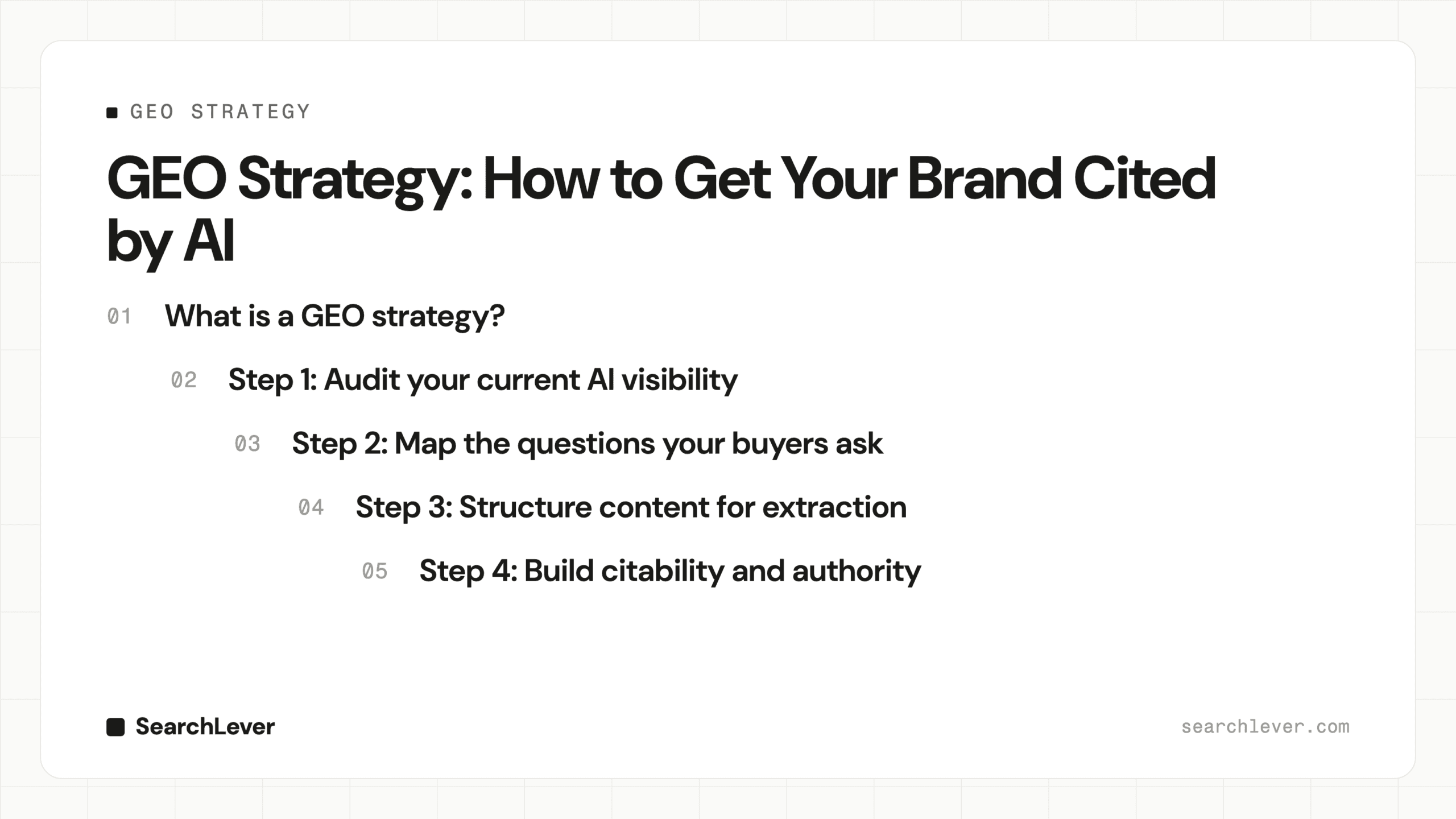
Table of Contents
- Key takeaways
- What is a GEO strategy?
- Step 1: Audit your current AI visibility
- Step 2: Map the questions your buyers ask
- Step 3: Structure content for extraction
- Step 4: Build citability and authority
- Step 5: Earn off-site mentions
- Step 6: Measure and iterate
- What does a GEO strategy look like for B2B SaaS?
- How do you resource a GEO strategy?
- What are common GEO strategy mistakes?
- Frequently asked questions
- How is a GEO strategy different from an SEO strategy?
- Where should a B2B SaaS company start with GEO?
- How long does a GEO strategy take to work?
- Do off-site mentions really matter for GEO?
- What is citation share of voice?
A GEO strategy is a plan for earning citations inside AI-generated answers from engines like ChatGPT, Perplexity, Google AI Overviews, and Gemini. It works in six steps: audit your current visibility, map the questions buyers ask, structure content for extraction, build citability, earn off-site mentions, and measure what changes. This guide covers each step in order.
Key takeaways
- A GEO strategy turns one-off content into a repeatable system for getting cited by AI engines.
- Start with an audit so you know which buyer questions you already win and which you lose.
- Structure beats volume: a page that answers a question cleanly outperforms a longer page that buries the answer.
- Off-site mentions on trusted sources do most of the heavy lifting for citations.
- Measure citation share of voice, not rankings, to know whether the strategy is working.

What is a GEO strategy?
A GEO strategy is the operating plan behind generative engine optimization. If you are new to the concept, our explainer on what generative engine optimization is covers the basics, and the complete GEO guide goes deeper on the mechanics. This article is the playbook: the sequence of moves that gets a B2B SaaS brand from invisible to cited.

Step 1: Audit your current AI visibility
You cannot improve what you have not measured. Begin by listing the questions your buyers ask AI engines, then run each one through ChatGPT, Perplexity, and Gemini and record whether your brand appears and who is named in your place. Our free AI Search Visibility Checker runs this scan across all three engines and returns a citation score plus the competitors cited instead of you. That score becomes your baseline, and the gaps it surfaces become your roadmap.
Step 2: Map the questions your buyers ask
AI answers are organized around questions, so your strategy has to be too. Build a list of the real prompts a buyer would type at each stage: problem-aware questions early, category and comparison questions in the middle, and vendor-specific questions late. Pull these from sales calls, support tickets, and the autocomplete on the engines themselves. Group them by intent, then prioritize the questions where a citation would most influence a deal.
Step 3: Structure content for extraction
Generative engines lift answers from content that states the point cleanly. For every priority question, give the engine a clean sentence to quote. Lead each section with a direct answer under a question-style heading, keep that answer self-contained so it makes sense out of context, and put the supporting detail underneath. Add comparison tables for “best” and “vs” queries, and add an FAQ section that mirrors the exact phrasing buyers use. We explain why your FAQ page is becoming your homepage for AI search in a separate piece.
Step 4: Build citability and authority
Engines prefer sources they can trust. You earn that trust by publishing claims an engine can verify and by being consistent about who you are across the web. Three moves matter most. Publish original data, benchmarks, or frameworks that other pages will cite, since a unique statistic is the most quotable asset you can own. Define your category terms clearly so the engine learns to associate your brand with them. And keep your firmographic details, product descriptions, and positioning consistent on your site, your profiles, and third-party listings.
Step 5: Earn off-site mentions
Most AI citations point to sources other than your own website. Review sites, comparison articles, industry publications, and community threads all feed the engines. To show up in those answers, you need to show up in those sources. Get listed and accurately described on the review platforms in your category, contribute to the publications your buyers read, and make sure independent pages describe your product the way you would. This off-site presence often moves your citation rate more than anything you publish on your own domain.
Step 6: Measure and iterate
Track citation share of voice, which is how often you appear across a set of buyer questions compared with competitors. Re-run your visibility scan on a fixed schedule, watch how your score moves as you ship changes, and double down on the formats that earn citations. Our guide on how to track your AI search visibility lays out the metrics and cadence in detail.
What does a GEO strategy look like for B2B SaaS?
B2B SaaS has a specific advantage and a specific risk in GEO. The advantage is that buyers ask AI engines highly commercial questions, like which platform fits a use case or how two products compare, and a citation in those answers reaches a prospect with real intent. The risk is that your category may already be dominated by a few names the engines repeat, so breaking in takes deliberate work.
A SaaS-focused plan concentrates on three question types. Category questions, such as “best tools for X,” where you need to appear on the review sites and comparison pages engines pull from. Comparison questions, such as “X vs Y,” where a clear, fair comparison page on your own site can earn the citation. And use-case questions, such as “how to solve problem Z,” where a direct, sourced answer positions your product as the solution. Build content and off-site presence against those three, in that order, and you cover the questions that actually move pipeline. Our SaaS SEO guide covers the organic foundation this runs on.
How do you resource a GEO strategy?
GEO needs three skills: a content lead who can structure answers, someone comfortable with technical SEO and schema, and a person who can earn placements on third-party sources. In a small team these may be one or two people splitting the work, and the audit-first sequence keeps the effort focused so a lean team is not overwhelmed. The work is steady rather than heavy once the system is running, since most of it is restructuring existing pages and maintaining off-site presence. Teams that lack the bandwidth or the technical depth often run GEO alongside their traditional search program through a partner, which is the model we use at SearchLever.
What are common GEO strategy mistakes?
Two errors slow most teams down. The first is treating GEO as a content-volume problem and publishing more pages instead of better-structured ones, which gives engines more text but no cleaner answers. The second is ignoring off-site presence and expecting on-site content alone to earn citations, when the trusted third-party sources are where many answers come from. A balanced strategy fixes both.
If you want a team to run this end to end alongside your traditional search program, see how SearchLever runs GEO and SEO together.
Frequently asked questions
How is a GEO strategy different from an SEO strategy?
An SEO strategy aims to rank pages so people click through, while a GEO strategy aims to get your brand cited inside AI answers. They share the same foundation of crawlable, authoritative content, so most teams run them as one program with two sets of metrics.
Where should a B2B SaaS company start with GEO?
Start with an audit. Run your top buyer questions through ChatGPT, Perplexity, and Gemini to see whether you are cited and who is named instead. That baseline tells you which questions to prioritize and what content to fix first.
How long does a GEO strategy take to work?
Pages that are already crawlable and trusted can appear in AI answers within weeks of being restructured. Earning citations on new topics takes longer because engines need to re-crawl your content and build trust in your brand as a source.
Do off-site mentions really matter for GEO?
Yes. A large share of AI citations point to review sites, comparison articles, and publications rather than the vendor’s own site. Being accurately described on those trusted sources is one of the strongest levers in a GEO strategy.
What is citation share of voice?
Citation share of voice measures how often your brand appears in AI answers across a set of buyer questions, compared with competitors. It is the GEO equivalent of rank tracking and the clearest signal that a strategy is working.
See where you stand with AI search
Two free tools: score your brand's AI-search readiness, or see which brands AI names in your category.

GTM & Growth Engineering
13+ years building revenue systems across B2B SaaS, fintech, and global operations. Previously at IBM, WorldRemit, Uber, and Janus Henderson. Clay Product Expert. Builds the GTM infrastructure and software layer that ties organic to pipeline.

SEO & Content Engineering
12+ years in technical SEO, currently SEO Manager EMEA at GoDaddy. Previously led SEO for Hawkers Group, Europe Assistance, Klorane, and Puressentiel. Founded Pixel News. Botify Pro certified. Specializes in site architecture, crawl optimization, and international SEO across 5 languages.