How to Track Your AI Search Visibility
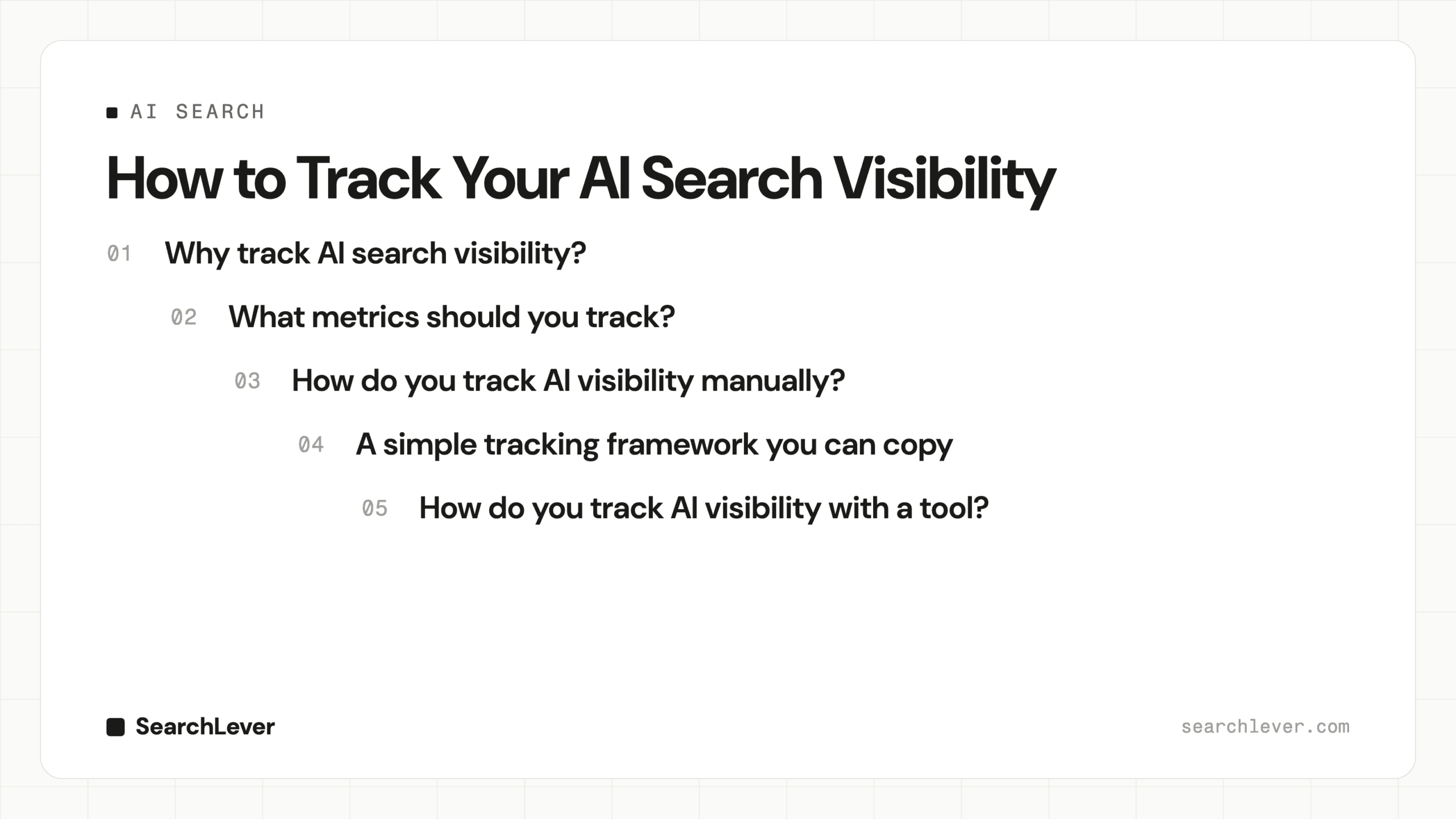
Table of Contents
- Key takeaways
- Why track AI search visibility?
- What metrics should you track?
- How do you track AI visibility manually?
- A simple tracking framework you can copy
- How do you track AI visibility with a tool?
- How often should you check?
- What should an AI visibility report include?
- How do you turn tracking into action?
- Frequently asked questions
- What is AI search visibility?
- Can you track whether ChatGPT mentions your brand?
- What is a good AI visibility score?
- How is AI visibility tracking different from rank tracking?
- How often should I track AI search visibility?
To track your AI search visibility, measure how often AI engines like ChatGPT, Perplexity, and Google AI Overviews mention your brand when answering your buyers’ questions. Run a fixed set of questions through each engine on a regular schedule, record whether you are cited and who appears instead, and trend that citation rate over time. This article covers the metrics, the method, and the cadence.
Key takeaways
- AI search visibility is how often AI engines cite your brand for the questions your buyers ask.
- The four metrics that matter are presence rate, citation share of voice, competitor share, and answer sentiment.
- You can track it manually with a question set and a spreadsheet, or automatically with a visibility tool.
- Use a fixed question set and a fixed schedule so your numbers are comparable across runs.
- Tracking only pays off when each scan feeds a specific content or off-site fix.
Why track AI search visibility?
Buyers increasingly research with AI tools, and the answer they receive shapes the shortlist before a sales conversation begins. If you are not measuring your presence in those answers, you have no idea whether you are in the consideration set or shut out of it. Tracking turns AI search from a black box into a metric you can manage, the same way rank tracking did for classic SEO. For the wider context, our piece on what the early AI search data tells us shows why this matters now.
What metrics should you track?
Four metrics give you a complete picture.
- Presence rate. The share of your tracked questions where your brand is mentioned at all. This is your headline number.
- Citation share of voice. How often you appear compared with competitors across the same question set. This shows your relative position, not just your raw presence.
- Competitor share. Which rival brands are named in the answers you lose. This tells you who is winning the citations you want.
- Answer sentiment. How the engine describes you when it does mention you, since a citation with a weak description is worth less than a strong one.

How do you track AI visibility manually?
The manual method is simple and free. Build a list of 20 to 50 buyer questions across problem-aware, category, and comparison intent. Run each question through ChatGPT, Perplexity, and Gemini, and log four fields per question: whether you were mentioned, which competitors were named, how you were described, and the date. Repeat the exact same questions on a schedule so the runs are comparable. The drawback is effort, since doing this by hand across three engines every month adds up quickly.
A simple tracking framework you can copy
If you track manually, a single spreadsheet keeps the work organized. Use one row per question and one tab per monthly run, with these columns.
- Question. The exact prompt, kept identical across every run.
- Intent. Problem-aware, category, or comparison, so you can see where you are strong and weak by funnel stage.
- Mentioned. Yes or no, per engine, which rolls up to your presence rate.
- Competitors named. Who appeared instead, which builds your competitor-share view.
- Description. How the engine characterized you, for sentiment.
- Action. The fix the result points to, so the scan never ends without a next step.

At the bottom of each tab, compute presence rate as mentions divided by total questions, per engine and overall. Comparing that figure across tabs is your trend. The same structure underpins automated tools, so starting in a spreadsheet teaches you what the numbers mean before you adopt one.
How do you track AI visibility with a tool?
A visibility tool automates the question set across engines and returns a single score you can trend. Our free AI Search Visibility Checker runs your keywords through ChatGPT, Perplexity, and Gemini, scores your citation rate from zero to one hundred, and lists the competitors cited instead of you. When you evaluate any tracker, look for multi-engine coverage, a clear and repeatable score, and competitor visibility, so you can see not only your number but who you are losing to. This connects directly to the audit step in a full GEO strategy.
How often should you check?
Monthly works for most B2B SaaS teams, because AI answers change as engines re-crawl the web and as your content and off-site mentions shift. Check more often, around every two weeks, when you are actively shipping GEO changes and want to see what moves the number. Always run the same question set on each pass, since changing the questions makes the trend meaningless.
What should an AI visibility report include?
When you report AI visibility to leadership, keep it to four things they can act on. Show the headline presence rate and how it moved since last period, so the trend is obvious at a glance. Show citation share of voice against your top two or three competitors, since relative position matters more than a raw number. List the highest-value questions where a competitor is cited and you are not, framed as the opportunities they are. And tie each opportunity to a planned fix and an owner, so the report drives work rather than just describing a problem. A report built this way turns AI visibility from a curiosity into a line item the business tracks.
How do you turn tracking into action?
A score on its own changes nothing. For each question where a competitor is cited and you are not, ask why their source was easier to quote, then fix the gap: restructure the page to lead with a direct answer, publish the data or comparison the engine wants, or earn a mention on the third-party source it pulled from. Re-scan after the change to confirm the fix worked. The discipline is a loop of measure, fix, and re-measure, which is the heart of generative engine optimization. If you want the loop run for you, see how SearchLever does it.
Frequently asked questions
What is AI search visibility?
AI search visibility is how often AI engines such as ChatGPT, Perplexity, and Google AI Overviews mention or cite your brand when they answer your buyers’ questions. It is the AI-era equivalent of search rankings.
Can you track whether ChatGPT mentions your brand?
Yes. Run a fixed set of buyer questions through ChatGPT and record whether your brand is named. A visibility tool automates this across ChatGPT, Perplexity, and Gemini and reports a citation score you can trend over time.
What is a good AI visibility score?
It depends on your category and maturity, so the most useful comparison is against yourself over time and against the competitors named in your question set. A rising presence rate and citation share of voice matter more than any single absolute number.
How is AI visibility tracking different from rank tracking?
Rank tracking measures your position in a list of links, while AI visibility tracking measures whether you appear inside a generated answer. The answer often replaces the click, so visibility tracking captures influence that rank tracking misses.
How often should I track AI search visibility?
Monthly suits most teams, moving to every two weeks while you actively ship GEO changes. Always use the same question set on each run so the results stay comparable.
See where you stand with AI search
Two free tools: score your brand's AI-search readiness, or see which brands AI names in your category.

GTM & Growth Engineering
13+ years building revenue systems across B2B SaaS, fintech, and global operations. Previously at IBM, WorldRemit, Uber, and Janus Henderson. Clay Product Expert. Builds the GTM infrastructure and software layer that ties organic to pipeline.

SEO & Content Engineering
12+ years in technical SEO, currently SEO Manager EMEA at GoDaddy. Previously led SEO for Hawkers Group, Europe Assistance, Klorane, and Puressentiel. Founded Pixel News. Botify Pro certified. Specializes in site architecture, crawl optimization, and international SEO across 5 languages.