Programmatic SEO Examples: SaaS Companies Doing It Right
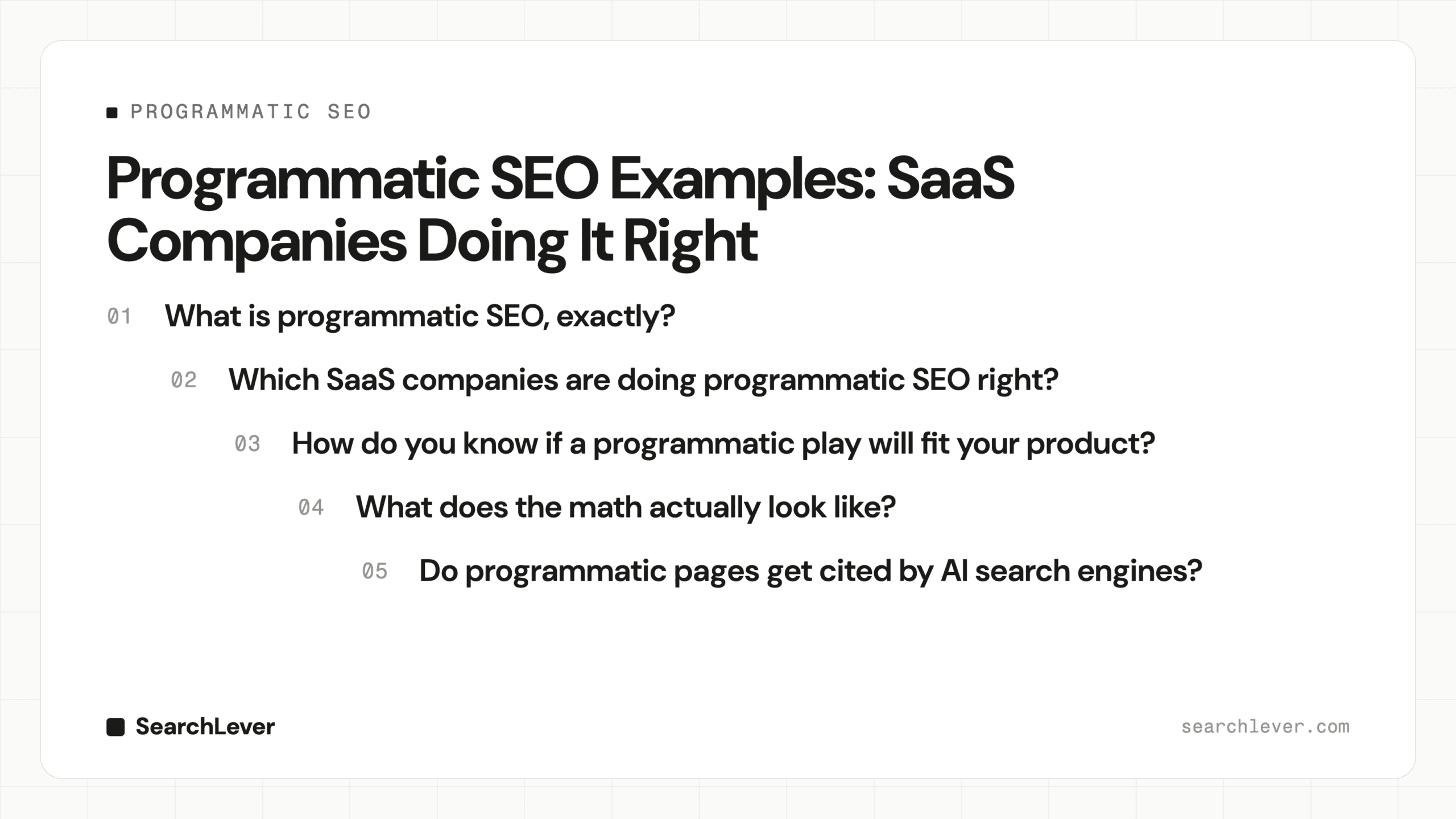
Table of Contents
- Key takeaways
- What is programmatic SEO, exactly?
- Which SaaS companies are doing programmatic SEO right?
- Zapier: integration pairs as a product graph
- Wise: pages that are worth loading twice
- Datadog: documentation that ranks
- HubSpot: utility over word count
- G2: reviews as a renewable dataset
- How do you know if a programmatic play will fit your product?
- What does the math actually look like?
- Do programmatic pages get cited by AI search engines?
- Why do most programmatic SEO projects fail?
- Frequently asked questions
- How many pages do you need for programmatic SEO to be worth it?
- Does Google penalize programmatic SEO?
- Can you use AI to write programmatic SEO pages?
- How long does a programmatic SEO program take to produce results?
- Should programmatic pages live in a subfolder or on the main site?
Programmatic SEO creates hundreds or thousands of pages from one template and one structured dataset. The SaaS companies doing it well, including Zapier, Wise, Datadog, and Ramp, all point the template at proprietary data their competitors cannot copy: integration metadata, live exchange rates, or aggregated vendor pricing. The template is the cheap part; the dataset is the moat.
Key takeaways
- Every durable programmatic SEO example is built on a dataset the company already owns as a byproduct of running its product.
- Search demand has to exist at the row level. If nobody searches for the individual variations, a template just manufactures index bloat.
- Expect a power-law outcome: in a 400-page program, 30 to 50 pages typically carry most of the traffic and nearly all of the pipeline.
- Programmatic pages are strong candidates for AI citation when each page states a specific, checkable fact that answers a specific question.
- The failure mode is almost always operational: duplicate templates, unmaintained data, and no crawl or quality monitoring after launch.
What is programmatic SEO, exactly?
Programmatic SEO is the practice of generating a large set of pages from a single page template populated by a structured dataset, where each row of the dataset becomes one page targeting one specific query. A row might be an integration pair, a currency route, a job title, or a product comparison.
Two components decide whether it works. The dataset is the table of rows and attributes behind the pages. The template is the layout, copy scaffolding, internal linking, and schema markup applied to each row. Teams tend to obsess over the template. The dataset is what determines whether the pages deserve to exist.
This sits at the top of the funnel. A buyer searching “connect Salesforce to Slack” or “Datadog PostgreSQL integration” has a problem, not a vendor shortlist. Programmatic pages catch that moment at volume, then hand qualified visitors to the rest of your B2B SaaS SEO program.
Which SaaS companies are doing programmatic SEO right?
| Company | Page pattern | Data behind it | Why it holds up |
|---|---|---|---|
| Zapier | “Connect App A with App B” | Live trigger and action metadata from 8,000+ connected apps | Each page reflects functionality only Zapier can enumerate |
| Wise | Currency conversion and send-money routes | Live mid-market rates and corridor fees | Data changes by the minute, so the page is genuinely useful on arrival |
| Datadog | Integration and metric catalog pages | 800+ integrations, each with its own metric definitions | Matches how engineers actually search: by tool name plus metric |
| HubSpot | Free tools, templates, and calculators | Internal benchmark data plus utility built in-house | The page does a job, so it earns links and repeat visits |
| G2 | “Product X vs Product Y” comparisons | Verified user reviews and structured feature grids | Review volume makes the comparison hard to replicate |
Zapier: integration pairs as a product graph
Zapier’s integration directory is the reference case. Every connected app produces a page, and every viable pairing produces another. The copy on any single page is modest. The value comes from the underlying graph: which triggers exist, which actions they map to, and which templates other users have already built. A competitor cannot copy the pages without first building the integrations.
Wise: pages that are worth loading twice
Currency conversion pages answer a question with a number that changes constantly. That gives Wise something most programmatic pages lack, which is a reason to return. It also produces clean, extractable answers, exactly the format that AI answer engines prefer to quote.
Datadog: documentation that ranks
Datadog treats its integration catalog as both documentation and acquisition. Each page lists the specific metrics collected, setup steps, and configuration details. The searcher is an engineer evaluating whether Datadog covers their stack, and the page answers that in seconds. Very little of it reads like marketing.
HubSpot: utility over word count
HubSpot’s free tools, generators, and template pages are programmatic in structure and functional in nature. Each page solves a small job for free. That earns editorial links at a rate content pages rarely match, and links flow through internal linking to the commercial pages that matter.
G2: reviews as a renewable dataset
Comparison pages capture buyers late in evaluation. G2 can generate them at scale because reviews arrive continuously and populate the feature grid automatically. The dataset refreshes itself, which is the property most in-house programmatic projects are missing.
How do you know if a programmatic play will fit your product?
Run four checks before writing a single template.
- Dataset ownership. Do you already hold structured data as a byproduct of the product? Integrations, usage benchmarks, pricing, taxonomies, and marketplace listings all qualify. Scraped or licensed data gives you no advantage.
- Row-level demand. Pull search volume for 30 sample rows. If more than half return zero, the head term is real but the long tail is imaginary.
- Answer specificity. Can each page state a fact that differs meaningfully from its neighbors? If swapping two rows changes only a product name, the pages are duplicates in Google’s eyes.
- Commercial adjacency. Is the searcher one step from a product decision? Pages about topics your product cannot serve will rank and produce nothing.

Three yeses is usually enough. Two is a signal to spend the budget on demand-driven content that converts to pipeline instead.
What does the math actually look like?
Here is a realistic model for a mid-market data platform with 240 native integrations.
- Scope: 240 single-integration pages plus the 160 highest-demand pairings, so 400 pages total.
- Build cost: roughly $22,000 across template design, data pipeline work, engineering time, and editorial review of the top 50 pages.
- Outcome at month nine: 310 of 400 pages indexed. Around 45 pages rank in the top three and produce roughly 8,000 monthly sessions. The remaining 265 indexed pages contribute about 2,500 sessions combined.
- Conversion: at a 1.4% visit-to-trial rate, that is 147 trials per month. At a 9% trial-to-opportunity rate, that is 13 opportunities.
- Payback: with a $14,000 average contract value and a 22% close rate, the program returns its build cost inside the first two closed deals.

Two things stand out. First, the distribution is brutally uneven, so the editorial investment belongs on the 50 pages with real demand. Second, the model only works if you can attribute the outcome, which means tracking pipeline back to the page group from day one rather than reporting on sessions.
Do programmatic pages get cited by AI search engines?
They can, and the ones that do share a shape. Generative engines extract passages that make a specific claim in a self-contained sentence. A page that says “Datadog’s PostgreSQL integration collects 84 metrics, including connection counts and replication delay” is quotable. A page that says “our integration helps teams monitor their database” is not.
Three template decisions raise citation odds materially. Put the direct answer in the first 60 words. Include a small comparison or specification table, since tables survive extraction well. Add a short question-and-answer block per page, because question-shaped content is disproportionately quoted by AI systems.
Programmatic pages also give you scale in entity coverage, which matters for generative engine optimization. Being the source that documents 800 integrations makes you the obvious citation for questions about any one of them. Once the pages ship, measure it: our AI visibility tracker shows which prompts surface your pages and which surface a competitor instead.
Why do most programmatic SEO projects fail?
The common causes are operational rather than strategic.
- Publishing everything at once. Shipping 5,000 pages in a week invites a quality review. Release in batches of 200 to 500 and confirm indexation before the next batch.
- No stale-data process. Pages built on a dataset nobody refreshes decay into inaccuracy within two quarters. Assign an owner and a refresh cadence.
- Cannibalization. Integration pages, comparison pages, and blog posts targeting the same query split authority. Map intent per template before you build.
- Crawl budget waste. Faceted variations and parameter duplicates can multiply 400 real pages into 12,000 crawlable URLs. A technical audit before launch catches this cheaply.
- Zero post-launch monitoring. Track indexation rate, impressions per page group, and pipeline per template as a cohort, not as one blended traffic line.
A useful safeguard: set a quality floor and enforce it. If a page cannot present at least three specific, accurate data points about its subject, it stays out of the sitemap until it can.
Frequently asked questions
How many pages do you need for programmatic SEO to be worth it?
Below about 50 pages, a template rarely pays for the engineering work, and you are better off writing the pages manually. The economics improve sharply between 200 and 2,000 pages. Above roughly 10,000 pages, quality control and crawl management become the dominant cost, so only attempt that scale with a dataset that maintains itself.
Does Google penalize programmatic SEO?
Google penalizes scaled content abuse, which it defines as generating many pages primarily to manipulate rankings with little value to users. Programmatic pages built on genuine data that answers a real query are treated like any other page. The distinction Google applies is user value per page, so the practical test is whether a human searching that exact query would find the page useful.
Can you use AI to write programmatic SEO pages?
Use AI for the connective copy and the data for the substance. Pages where a model invents the details read as generic and get filtered quickly. A workable split is structured data for every factual element, AI-assisted drafting for transitions and summaries, and human review for the 10 to 15 percent of pages carrying the most demand.
How long does a programmatic SEO program take to produce results?
Plan on four to six weeks for the dataset and template, then three to six months for indexation and ranking to stabilize. Integration and comparison pages on established domains move faster, sometimes in eight to ten weeks. New domains with low authority should expect nine months before the traffic curve is meaningful.
Should programmatic pages live in a subfolder or on the main site?
Keep them on the primary domain in a clearly scoped subfolder, for example /integrations/ or /compare/. That keeps the authority consolidated and makes cohort reporting simple. Subdomains split signals and add measurement overhead, and separate microsites almost always lose the internal links that make these pages perform. Pair the subfolder decision with a clear GEO strategy so the same pages work in both classic search and AI answers.
See where you stand with AI search
Two free tools: score your brand's AI-search readiness, or see which brands AI names in your category.

GTM & Growth Engineering
13+ years building revenue systems across B2B SaaS, fintech, and global operations. Previously at IBM, WorldRemit, Uber, and Janus Henderson. Clay Product Expert. Builds the GTM infrastructure and software layer that ties organic to pipeline.

SEO & Content Engineering
12+ years in technical SEO, currently SEO Manager EMEA at GoDaddy. Previously led SEO for Hawkers Group, Europe Assistance, Klorane, and Puressentiel. Founded Pixel News. Botify Pro certified. Specializes in site architecture, crawl optimization, and international SEO across 5 languages.